User Management
Traccar supports individual accounts and organizations with administrators, managers and regular users. A user's role, restrictions and limits determine what they can do. Connections to devices and other objects determine what they can access. See Permissions and Groups for assigning access.
User roles
| Role | Capabilities |
|---|---|
| Administrator | Full access to all users and objects on the server. Can change user roles and limits. |
| Manager | Can manage assigned users and create new users within their user limit. Can share objects they have access to with those users. |
| User | Can access assigned objects and create or edit objects subject to their restrictions and limits. |
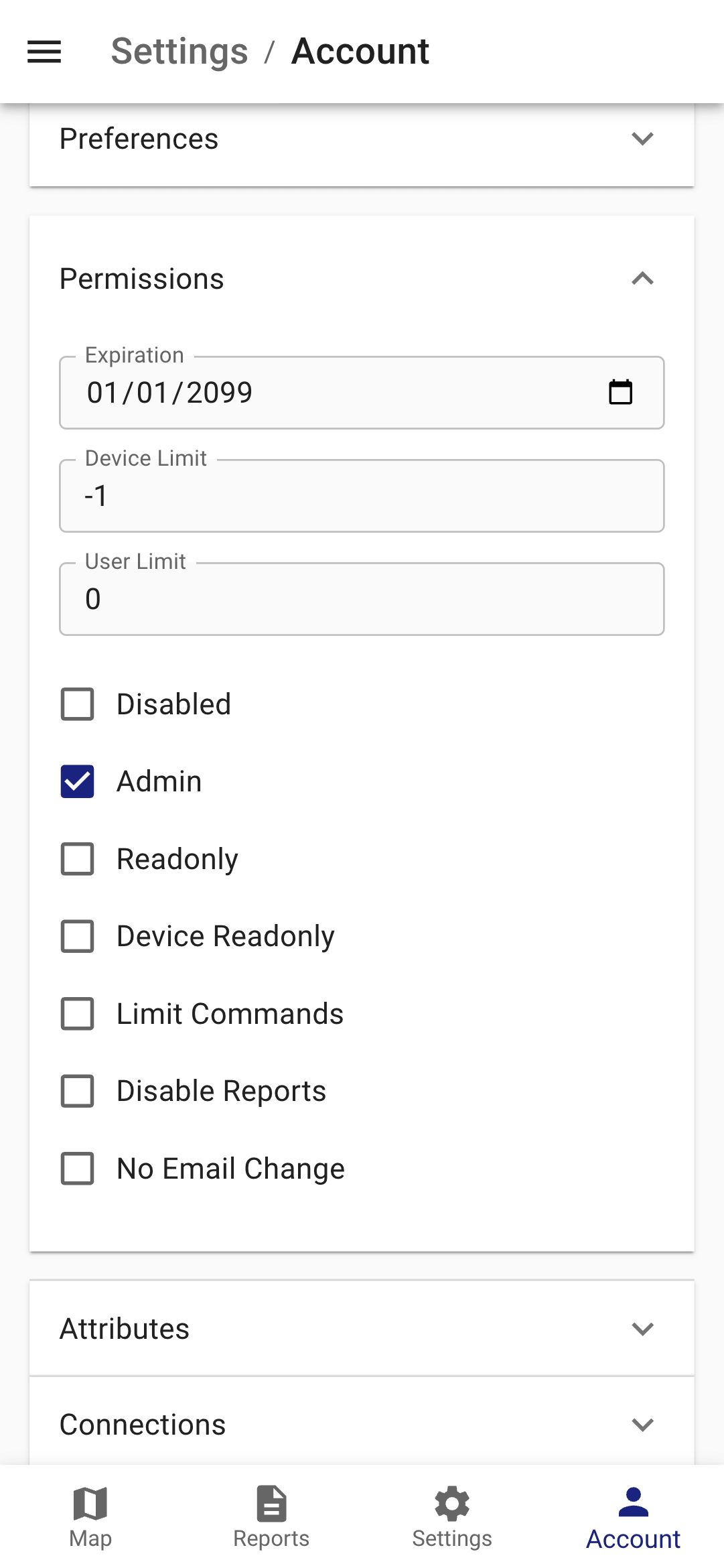
To make a user an administrator, enable Administrator in their account settings. To make a non-administrator a manager, set their User limit to a positive number or -1. A user limit of 0 makes the account a regular user.
Administrators can manage accounts under Settings > Users. Managers use the same page to manage their assigned users.
User restrictions
Restrictions apply to a user's account in addition to their role:
- Read-Only prevents changes to objects and their connections. Use it for users who need to view assigned objects without editing them.
- Device Read-Only prevents adding, editing or deleting devices. The user can still work with other objects, such as geofences and notifications, subject to their other restrictions.
These settings apply across the user's accessible objects, including shared objects. They are not separate roles or permissions that can be set differently for each device. Server-wide restrictions also apply to non-administrator accounts.
User limits
Only an administrator can change Device limit and User limit.
| Value | Device limit | User limit |
|---|---|---|
| -1 | No limit on adding devices. | Manager with no limit on adding users. |
| 0 | Cannot add devices. | Regular user; cannot manage other users. |
| Positive number | Can add devices until the number of accessible devices reaches the limit. | Manager who can add users until the number of managed users reaches the limit. |
The device count includes devices accessible through groups. A device limit of 0 does not prevent editing or deleting existing devices. Use Device Read-Only for that restriction.
Users created by a manager start with both limits set to 0. Self-registered users have a device limit of -1, unless a different default is configured with users.defaultDeviceLimit in the server configuration.
Account status and expiration
Disabled prevents the user from logging in. Non-administrators cannot change this setting on their own account. A manager can change it for users they manage.
Expiration time sets the time after which the user cannot log in. A manager with an expiration time cannot remove an expiration time or extend it beyond their own, including when editing their own account. Administrators can change expiration times without this restriction.
Embedded or public view
Use a dedicated account to share a view of selected devices:
- Create a user account.
- Assign the devices or groups that should be visible through the user's Connections menu. See Permissions and Groups.
- Enable Read-Only for the account.
- Log in as that user and open Settings > Preferences > Token.
- Select a token expiration time, generate the token and copy it.
Use the token in your server URL, for example:
https://tracking.example.com/?token=YOUR_TOKEN
Anyone with this URL can access the account using the token. Share only the dedicated account's token and assign only objects intended for that audience.
Traccar as a service
A service administrator can create one manager account for each client. For example, set User limit to 5 and Device limit to 50, then set Expiration time to the end of the subscription period.
The manager can add up to 5 users and create devices until they have access to 50 devices. They can organize devices into groups and share devices, geofences and other objects with their users.
Keep the managed users' device limits at 0 if all new devices should be created through the manager account. The manager's device limit is checked when the manager adds a device; it is not a separate organization-wide quota. If an administrator allows managed users to add devices, those users have their own limits.