Permissions and Groups
Connections control access to objects such as devices, groups, geofences and notifications. A user's role and restrictions determine what they can do with those objects. See User Management for roles, read-only settings and limits.
Connection types
| Connection | Purpose | Example |
|---|---|---|
| User to object | Gives the user access to the object. | Link a geofence to a user so they can access it. |
| User to group | Gives the user access to the group, its subgroups and their devices. | Link a fleet group to a dispatcher. |
| Device to object | Associates the object with that device. Does not grant users access to the object. | Link a geofence to a device to generate geofence events. |
| Group to object | Associates the object with devices in the group and its subgroups. Does not grant users access to the object. | Link a geofence to a fleet group to generate events for its devices. |
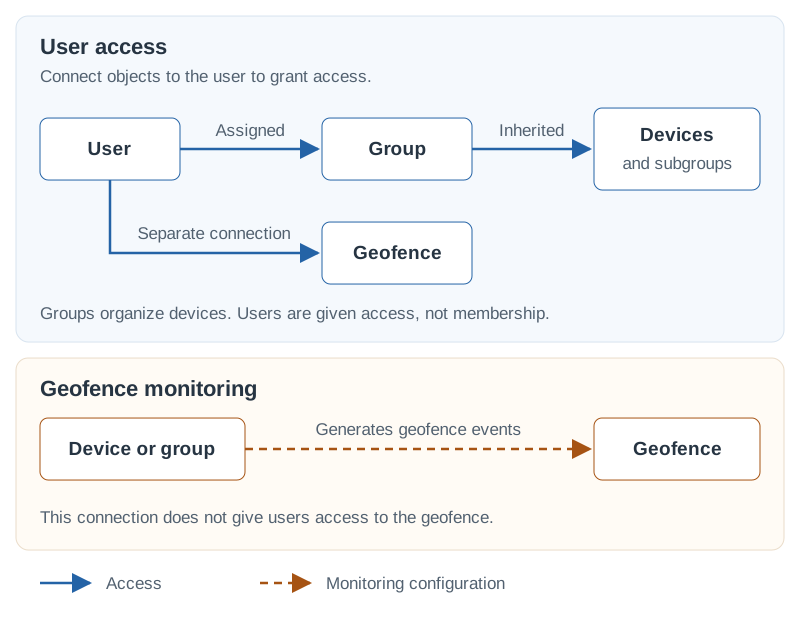
For example, linking a geofence to a device makes the system monitor that device entering and exiting the geofence. To give a user access to the geofence, also link it to the user. Access to the device alone does not grant access to its geofences.
Assigning user access
Administrators can assign access for any user. Managers can share their accessible objects with users they manage.
- Open Settings > Users.
- Open the user's Connections menu.
- Select the type of object, such as devices, groups or geofences.
- Select the objects to link to the user. Changes are saved automatically.
Sharing an object gives access to the same object, rather than creating a copy. Users can edit or delete shared objects unless their account restrictions prevent it. Changes affect everyone with access to the object.
Use Read-Only to prevent object changes, or Device Read-Only to prevent device changes while allowing work with other objects. If users need independent versions of a geofence or another object, create separate copies. Devices cannot be duplicated with the same unique identifier.
Unlinking and deleting
Unlinking an object in Connections removes that connection. It does not delete the object or remove other users' connections to it.
Deleting an object removes the shared object itself, affecting every user who had access to it. To remove one user's access, change their connections instead of deleting the object.
A user can have access to a device through both a direct connection and a group. Removing the direct connection does not remove access inherited from a group. Check both paths when removing access.
Device connections
To associate a geofence, notification or another supported object with a device, open Settings > Devices, then use the device's Connections menu.
These connections configure which objects apply to the device. User access is configured separately through the user's Connections menu. See Geofences and Events and Notifications for more details.
Groups
A group organizes devices, not users. Assigning a group to a user gives that user access to its devices and subgroups; it does not make the user a member of the group.
Each device can belong to one group, and a group can have a parent group to form a hierarchy. Other objects, such as geofences, can be linked to groups but are not group members.
To add a device to a group, edit the device and select Group under Extra. To nest a group, edit it and select its parent Group under Extra.
Assigning a group to a user grants access to the devices in that group and its subgroups. Devices added to the group become accessible through that connection. Moving a device out of the group can remove that access, unless the user has another connection to the device or its new group.
To associate a geofence or another supported object with a group, open Settings > Groups, then use the group's Connections menu. For example, a geofence linked to a group applies to all devices in the group and its subgroups. Users still need a separate connection to the geofence to access it.
Example: share a fleet with a dispatcher
- As an administrator, create a manager account with a positive User limit and a suitable Device limit.
- Create a fleet group, add devices to it, and assign the group to the manager through the manager's Connections menu.
- As the manager, create a regular user for the dispatcher.
- Assign the fleet group to the dispatcher to share the whole fleet, or assign individual devices to share only selected vehicles.
- Enable Device Read-Only on the dispatcher's account if they should manage geofences and notifications without changing devices. Use Read-Only if they only need to view objects.
- Assign any geofences or notifications the dispatcher needs through their Connections menu.
Troubleshooting
- A user cannot see a device: check their direct device connections and assigned groups. Check whether the device was moved to another group.
- A user still sees a device after it was unlinked: check whether an assigned group also grants access to it.
- A user cannot add devices: check their device limit, the number of devices they can access, and account or server read-only restrictions.
- A user cannot access a geofence linked to their device: link the geofence to the user as well. The device connection configures event generation, not user access.